
Search engine optimization is changing rapidly. A few years ago, many businesses focused mainly on keywords, backlinks, and publishing blog posts to improve their Google rankings. In 2026, SEO involves much more than these activities.
People now use traditional Google Search, AI Overviews, AI Mode, ChatGPT, and other AI-powered platforms to discover information, compare services, research products, and find solutions to their problems.
This change has created new opportunities for website owners, bloggers, digital marketers, and businesses.
However, one important thing has not changed: people still need accurate, useful, trustworthy information.
Google’s official 2026 guidance confirms that foundational SEO practices remain relevant for AI-powered search experiences. Websites should focus on valuable content, strong technical foundations, and satisfying user needs rather than relying on special AI ranking tricks.
What Is SEO in 2026?
Search Engine Optimization (SEO) is the process of improving a website’s content, technical structure, and overall usefulness so that search engines can discover, understand, and display its pages for relevant searches.
In 2026, SEO also involves making information accessible and useful across AI-powered search experiences.
For example, if someone searches for “best SEO agency for a small business,” Google may display traditional website results, AI-generated summaries, business listings, and other search features.
A business can improve its visibility by creating relevant service pages, publishing useful information, maintaining accurate business details, and ensuring its website is technically accessible.
SEO in 2026 includes several connected areas:
- Traditional search engine optimization.
- AI search optimization and GEO.
- Answer Engine Optimization (AEO).
- Helpful content and topical relevance.
- Technical SEO and website performance.
- Digital authority and trustworthy brand information.
The objective is not simply to get more visitors. It is to attract relevant users who can find answers, understand your services, and take meaningful action.
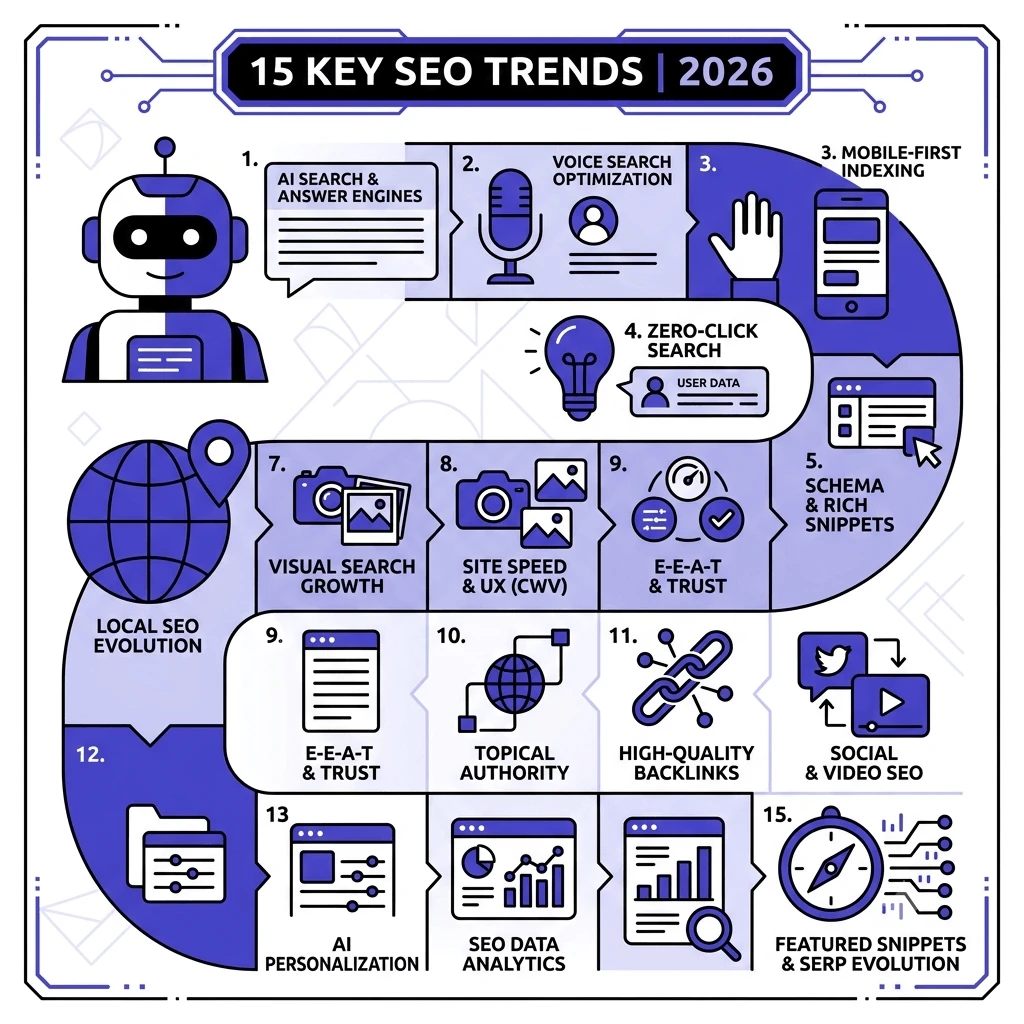
15 SEO Trends in 2026 You Need to Know
1. AI Search Optimization Is Becoming an Important Part of SEO
Major trend
AI-powered search is changing how people discover websites.
Google AI Overviews and AI Mode can generate responses to complex questions and provide links to relevant websites. Users can explore topics through follow-up questions instead of performing several separate searches.
For website owners, this creates another opportunity to reach people who are researching a topic.
Google’s official AI optimization guidance explains that its generative search features rely on its existing Search systems to find relevant information and identify supporting pages.
How to optimize your website for AI search
Start with these practical steps:
- Answer the main search query clearly near the beginning of the page.
- Provide detailed explanations, examples, and original information.
- Use descriptive headings that reflect the questions readers ask.
- Keep important content available in crawlable text.
- Support factual claims with reliable sources.
- Make sure your website can be crawled and indexed.
For example, if your target keyword is “What is technical SEO?”, begin with a short definition before explaining crawling, indexing, website speed, structured data, and other technical elements.
This helps readers understand the topic quickly while making the page’s purpose clear to search engines.
Important: There is no guaranteed method to appear in Google AI Overviews or AI Mode. Google says pages must meet its normal Search eligibility requirements, and indexing or display is never guaranteed.
2. Generative Engine Optimization (GEO) Is Gaining Attention
Generative Engine Optimization, commonly known as GEO, refers to improving the chances that a brand or its content is discovered, referenced, or linked in AI-generated responses.
Traditional SEO focuses on improving visibility in search engine results. GEO focuses more specifically on visibility within generative AI experiences.
These approaches overlap significantly.
For example, a digital marketing agency might publish a detailed guide about SEO pricing, explain different service packages, include real examples, and link to its relevant service pages.
If someone asks an AI platform about SEO costs, that content may be useful as a source, depending on the platform’s retrieval systems and the user’s query.
GEO strategies for 2026
| Strategy | How to implement it |
|---|---|
| Clear information | Explain concepts in direct, understandable language. |
| Original research | Publish genuine surveys, data, or case studies. |
| Reliable references | Support important claims with trustworthy sources. |
| Brand consistency | Keep business information accurate across platforms. |
| Relevant coverage | Address the main topic and closely related questions. |
Google’s 2026 guidance specifically recommends unique, valuable content rather than repeatedly publishing information already available elsewhere. It also warns against creating pages primarily to manipulate AI responses.
GEO should therefore be treated as an extension of a useful SEO strategy, not as a replacement for it.
3. Answer Engine Optimization (AEO) and Direct Answers
Answer Engine Optimization, or AEO, is the practice of organizing content so that users and answer-focused systems can easily understand the information being provided.
People often search using complete questions, such as:
- What is SEO and how does it work?
- How long does SEO take to show results?
- What are the most important SEO factors?
- How can a small business improve Google rankings?
AEO focuses on answering these questions clearly and accurately.
How to optimize content for AEO
Use the following structure:
Question heading: What is SEO?
Direct answer: SEO is the process of improving a website’s visibility in organic search results through useful content, technical improvements, and relevant authority signals.
Detailed explanation: Explain how SEO works, why businesses use it, and which steps beginners should follow.
Example: Show how optimizing a service page can help search engines understand what a business offers.
This structure is helpful because readers can quickly find the answer and continue reading for more detail.
Does AEO replace traditional SEO?
No. AEO is a content and presentation approach that works alongside traditional SEO. Google states that special AEO or GEO techniques are not separate requirements for appearing in its AI search features.
A well-optimized page should serve people first, whether they arrive from a traditional search result or an AI-powered experience.
4. Helpful, People-First Content Matters More Than Content Volume
Publishing more articles does not automatically improve search rankings.
A website with hundreds of short, repetitive articles may provide less value than a website with a smaller collection of detailed, original, and genuinely useful resources.
In 2026, businesses should focus on creating content that solves actual problems rather than publishing articles only to target keywords.
Google’s guidance emphasizes helpful, reliable, people-first content and warns against scaled content created primarily to manipulate search rankings.
What makes content helpful?
Useful content generally includes:
- A clear explanation of the subject.
- Accurate and up-to-date information.
- Examples that help readers apply the advice.
- Original insights or practical experience.
- Sources for important factual claims.
- Clear answers to common questions.
For example, instead of publishing a generic article titled “SEO Tips,” create a guide explaining how a small business can conduct keyword research, optimize its homepage, improve local visibility, and measure results.
Include examples of title tags, internal links, and content improvements.
This gives readers something they can actually use.
Should you use AI to write SEO content?
AI writing tools can assist with research, outlining, drafting, and editing. However, the final content should be checked for accuracy, originality, relevance, and usefulness.
AI-generated content is not automatically against Google’s policies. The concern is content produced at scale primarily to manipulate rankings, regardless of how it was created.
A practical workflow is:
- Research the topic and search intent.
- Use AI to prepare an outline or initial draft.
- Verify facts and references.
- Add original examples, insights, and experience.
- Edit the article into clear, natural language.
- Update the content when information changes.
The goal is to publish content that deserves to be read, not simply content that fills a website.
5. Search Intent and Topical Authority Are Essential
Search intent means understanding what a person actually wants when entering a search query.
Two keywords may contain similar words but require different content.
For example:
| Search keyword | Likely intent | Suitable content |
|---|---|---|
| What is SEO? | Informational | Beginner’s guide |
| SEO agency near me | Local commercial | Local service page |
| SEO services pricing | Commercial research | Pricing guide |
| Hire an SEO expert | Transactional | SEO service page |
If you want to rank a service page for a keyword with commercial intent, publishing a general educational article may not satisfy the searcher’s needs.
Build topical authority with topic clusters
Topical authority is the depth and relevance of a website’s coverage of a subject. It is not a single score that guarantees rankings.
A practical way to organize content is to create a central pillar page supported by related articles.
Pillar Page
Complete SEO Guide for Beginners
Connect relevant supporting articles to the pillar page and to each other where useful.
For example, a website targeting SEO services can publish supporting articles about local SEO, on-page SEO, technical SEO, keyword research, and content optimization.
Link these pages naturally so users can move between related topics.
Topical coverage should be useful and relevant. There is no need to create hundreds of pages for minor keyword variations.
6. E-E-A-T and Trust Signals Remain Important
E-E-A-T stands for Experience, Expertise, Authoritativeness, and Trustworthiness.
Google’s Search Quality Rater Guidelines use these concepts to help human quality raters assess search result quality. E-E-A-T is not itself a single ranking factor or a score that website owners can directly optimize. Trust is particularly important within this framework.
How to improve E-E-A-T on your website
Experience: Add genuine examples, original images, product testing, or documented project experience when relevant.
Expertise: Explain the subject accurately and demonstrate appropriate knowledge. For technical or sensitive subjects, use qualified reviewers where appropriate.
Authoritativeness: Build a recognizable brand, publish useful resources, and earn relevant editorial mentions.
Trustworthiness: Provide accurate information, transparent authorship, contact details, and clear policies.
For a digital marketing website, an author page might explain the writer’s experience with keyword research, website audits, Google Search Console, and SEO campaigns.
If an article discusses legal, medical, or financial topics, ensure the claims are properly verified and reviewed by a qualified professional where necessary.
Do not invent credentials, client results, testimonials, or first-hand experiences.
Trust is built through accurate and transparent information, not through adding an author box alone.
7. Technical SEO and Website Performance Still Matter
Content cannot perform well in search if search engines cannot properly discover, crawl, and index the page.
Technical SEO helps search engines access your website and helps visitors use it comfortably.
Google’s AI search documentation confirms that the same technical foundations used for traditional Search remain relevant to AI search visibility.
Technical SEO checklist for 2026
| Technical element | What to check |
|---|---|
| Crawling | Important pages are accessible to Googlebot. |
| Indexing | Pages intended for search are not accidentally blocked or noindexed. |
| XML sitemap | Important canonical URLs are included. |
| Internal links | Important pages can be discovered through crawlable links. |
| Mobile usability | Text, navigation, and forms work on mobile devices. |
| HTTPS | The website uses a secure connection. |
| Canonical tags | Duplicate or similar URLs are handled correctly. |
| Page experience | Content loads reliably without disruptive layout problems. |
Core Web Vitals and page speed
Core Web Vitals measure aspects of real-world page experience.
The three main metrics are:
| Metric | What it measures | Good target |
|---|---|---|
| LCP | Loading performance | 2.5 seconds or less |
| INP | Responsiveness | 200 milliseconds or less |
| CLS | Visual stability | 0.1 or less |
These thresholds are assessed at the 75th percentile of page visits, separately for mobile and desktop.
A fast website can make browsing easier, but good Core Web Vitals alone do not guarantee high rankings.
Use Google PageSpeed Insights and Search Console to identify performance issues and monitor improvements.
For WordPress websites, common areas to review include image compression, caching, unnecessary JavaScript, font loading, and layout shifts caused by ads or dynamically loaded elements.
8. First-Hand Experience and Original Content Can Differentiate Your Website
AI tools can summarize information that already exists online. This makes original information particularly useful for websites that want to stand out.
A page that simply repeats common advice may provide little additional value.
Instead, publish information that is difficult to obtain from a basic summary.
Examples of original SEO content
- A documented SEO case study showing changes made to a website.
- A comparison based on genuine product or software testing.
- Original survey results from business owners.
- Screenshots demonstrating a real SEO process.
- An analysis of your own Search Console data.
- A practical checklist developed through actual project work.
For example, an article about improving website speed could include screenshots of a real PageSpeed Insights audit, the problems identified, the changes implemented, and the measured results.
Clearly state the date, website conditions, and limitations of the example.
Google’s 2026 AI guidance highlights original perspectives and non-commodity information as useful ways to create content that stands apart.
9. Brand Authority and Digital PR Are Important for Online Visibility
A website’s visibility is influenced by more than its own pages.
People may discover a brand through industry publications, relevant websites, professional communities, social platforms, and other sources.
Digital PR involves sharing newsworthy information, research, useful resources, or expert commentary that may earn legitimate attention and editorial coverage.
Digital PR strategies for SEO
- Publish original research or useful industry statistics.
- Contribute accurate expert commentary to relevant publications.
- Create resources that other websites naturally want to reference.
- Build genuine relationships with publishers and industry professionals.
- Keep your brand name, website, and business details consistent.
Backlinks remain relevant to SEO, but buying links or participating in link schemes to manipulate rankings can violate Google’s spam policies.
Focus on earning relevant, genuine links rather than collecting large numbers of low-quality links.
Brand visibility and mentions can support discovery and reputation, but there is no verified formula that guarantees AI citations from a specific number of mentions or backlinks.
10. Local SEO and Google Business Profile Optimization
Local SEO is important for businesses that serve customers in a particular geographic area.
Examples include digital marketing agencies, restaurants, clinics, repair services, and local retailers.
When people search for services near them, Google may display a map and local business listings alongside traditional results.
How to improve local SEO in 2026
Optimize your Google Business Profile
- Use the correct business name and primary category.
- Maintain accurate address, phone number, and business hours.
- Add relevant services and genuine business photographs.
- Respond professionally to customer reviews.
- Keep business information up to date.
Create useful local landing pages
If your business serves multiple cities, create location pages that provide meaningful information about services available in each area.
Avoid publishing dozens of nearly identical pages that only replace the city name.
For example, an SEO agency serving Delhi and Noida can explain its services, service area, local business needs, and relevant examples on separate pages where the content genuinely differs.
Google’s AI optimization guidance also emphasizes accurate Business Profile information and relevant local content.
11. Video, Image, and Visual Search Optimization
Search engines do not rely only on written content.
People also discover information through image search, video results, and visual search experiences.
For many topics, a video or original image can explain something more clearly than a long paragraph.
Image SEO best practices
- Use descriptive, relevant image filenames.
- Add meaningful alt text that explains the image.
- Compress images without unnecessarily reducing quality.
- Use suitable image dimensions and responsive formats.
- Place images near the relevant text.
- Avoid using unrelated stock images simply to fill space.
For example, a blog about keyword research can include a screenshot of a keyword research process with a clear caption explaining what the reader should notice.
Video SEO best practices
Create videos that directly address the topic of the page.
Add descriptive titles, useful descriptions, and accurate captions. Where appropriate, provide a transcript or a written explanation of the video.
For tutorial content, show the actual process instead of relying entirely on generic animations.
Images and videos should support the written content rather than replace essential information that readers need in text form.
Google’s official guidance recommends supporting textual content with relevant, high-quality images and videos where appropriate.
12. Structured Data and Schema Markup
Structured data helps search engines understand information on a page by providing details in a standardized format.
It can describe things such as articles, products, businesses, organizations, and other supported entities.
For example, an Article schema can help identify the headline, author, publication date, and other information about a blog post.
Useful schema types for websites
| Schema | Common use |
|---|---|
| Article | Blog posts and editorial content |
| Organization | Business or organization information |
| LocalBusiness | Eligible local business information |
| Product | Product details and offers |
| BreadcrumbList | Page hierarchy and navigation |
Use the schema that accurately represents the visible content of the page.
Do not add false ratings, fake reviews, or information that users cannot see.
Does schema guarantee AI Overviews or featured snippets?
No. Google explicitly states that no special schema markup is required for inclusion in AI Overviews or AI Mode. Structured data should accurately describe your content and follow the applicable search guidelines.
For WordPress users, SEO plugins can help implement supported schema types, but always check for duplicate or incorrect markup.
13. Zero-Click Searches and Search Visibility Beyond Traffic
A zero-click search happens when someone gets the information they need directly from a search results page without visiting a website.
This can occur through featured snippets, knowledge panels, AI summaries, and other search features.
For publishers and businesses, this creates a measurement challenge.
A website may appear in search results and build brand visibility even when a user does not click through.
At the same time, fewer clicks for certain queries can affect organic traffic and advertising revenue.
How to respond to zero-click searches
Focus on topics where your website can provide additional value beyond a short answer.
For example, a user searching “What is SEO?” may only need a brief definition.
But someone searching “How to conduct a technical SEO audit for WordPress” may need a detailed process, examples, screenshots, and a checklist.
Create content that helps users complete the task rather than merely giving them a definition.
Measure multiple outcomes:
- Organic clicks and impressions.
- Search query visibility.
- Relevant website conversions.
- Leads, calls, and form submissions.
- Engagement with useful content.
Google reports AI-feature traffic within the overall Web search performance data in Search Console, rather than providing a separate AI Overview and AI Mode traffic category in the standard Performance report.
This means website owners should avoid assuming that all AI-driven visibility can be measured through a single, dedicated report.
14. Search Console Data and SEO Analytics
Successful SEO requires regular measurement.
Publishing content without checking performance makes it difficult to understand what is working and what needs improvement.
Google Search Console provides information about a website’s search impressions, clicks, average position, indexing, and other search-related data.
Google Analytics can help measure what users do after reaching your website.
SEO metrics to monitor in 2026
Organic impressions
Shows how often your website appears in search results. Increasing impressions can indicate growing search visibility.
Organic clicks and CTR
Measure how many users click your search listings and how often impressions result in clicks.
Conversions
Track meaningful actions such as leads, purchases, downloads, or contact form submissions.
Indexing and technical health
Check whether important pages are indexed and whether crawling or page experience issues need attention.
How to use Google Search Console
Step 1: Open Google Search Console and select your website property.
Step 2: Open the Performance report and select a suitable date range.
Step 3: Review queries and pages that receive impressions but relatively few clicks.
Step 4: Check whether the title, description, and page content match the search intent.
Step 5: Review pages with declining clicks or impressions and investigate possible technical or content issues.
Do not change every page simply because its average position fluctuates. Consider the query, seasonality, competition, search features, and the amount of data available before making changes.
15. AI Agents and the Future of Search
AI agents are systems designed to carry out tasks through multiple steps, sometimes interacting with websites and other services.
In search and commerce, these systems may help users research products, compare options, or complete certain online tasks.
For website owners, this raises questions about how websites present information and support automated interactions.
Google’s May 2026 AI optimization guidance discusses emerging agent-related experiences and encourages website owners to follow developments in this area.
How to prepare your website
- Keep service and product information accurate.
- Make important information accessible in readable formats.
- Use clear navigation and descriptive links.
- Maintain secure and reliable website functionality.
- Ensure that forms and key actions work properly.
- Follow established accessibility and technical standards.
For an e-commerce website, this may include maintaining accurate product names, availability, prices, shipping details, and return policies.
For a service business, it may mean clearly explaining services, pricing information where applicable, service areas, and contact methods.
AI agents are an evolving area. Not every website needs to implement special agent protocols today, and there is no guaranteed agent-specific ranking advantage.
The practical starting point is a clear, accessible, and reliable website.
How to Create an SEO Strategy for 2026: Step-by-Step
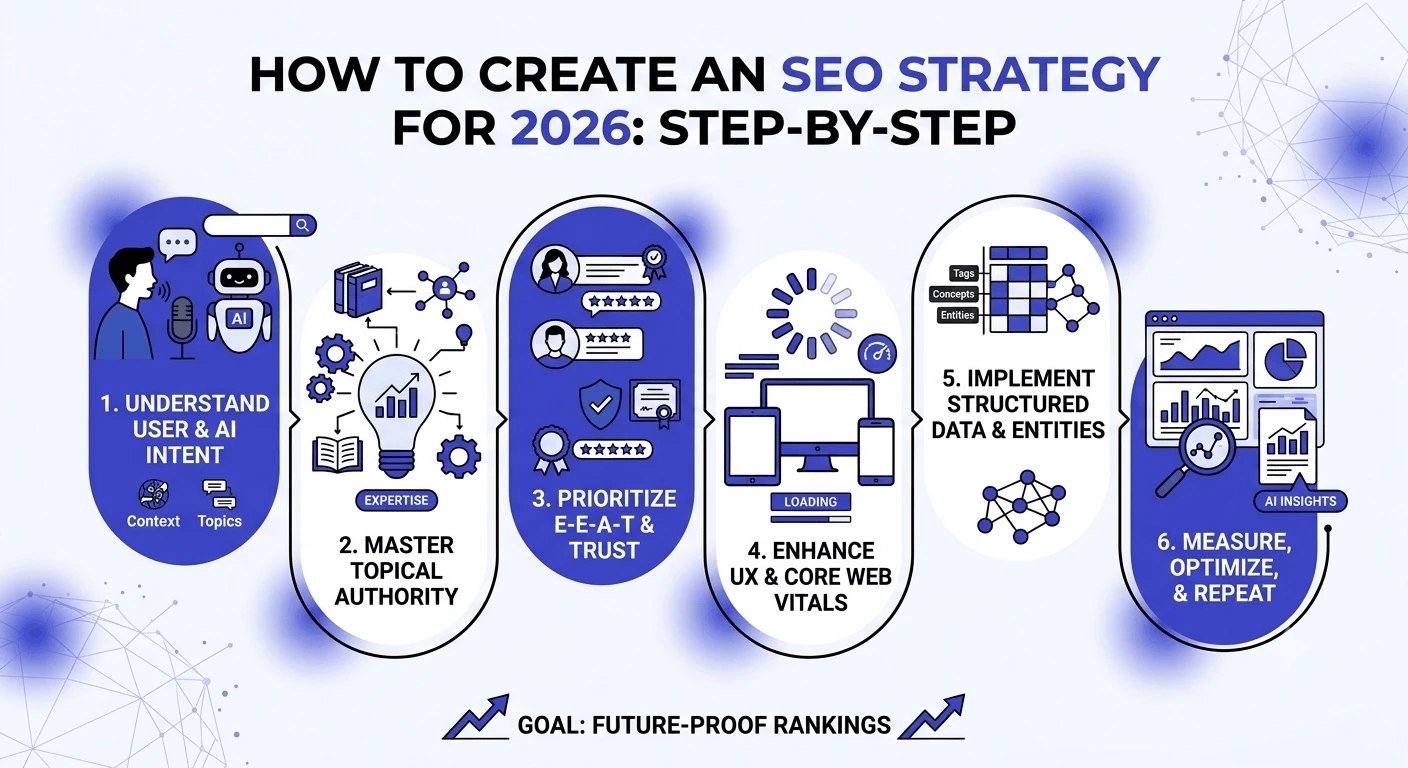
Understanding SEO trends is useful, but applying them consistently is what turns a strategy into actual work.
Here is a practical SEO process for bloggers, small businesses, and website owners.
Step 1: Conduct Keyword Research
Start by identifying the terms your target audience uses when searching for information, products, or services.
Use tools such as:
- Google Keyword Planner.
- Google Search Console.
- Semrush.
- Ahrefs.
- Google Trends.
Look at search intent, keyword relevance, competition, and the value of attracting visitors for each query.
Do not select keywords based only on search volume. A keyword with lower search volume may attract people who are more interested in your services.
Group related keywords into topics and assign each group to the most suitable page.
Step 2: Analyze Search Results and Competitors
Search for your target keyword and review the pages currently appearing in the results.
Ask these questions:
- What type of content is ranking?
- What questions do those pages answer?
- What information is missing?
- Are the results primarily articles, service pages, videos, or product pages?
- Can you provide more accurate or useful information?
The purpose is not to copy competitors.
It is to understand what searchers expect and identify opportunities to create something more useful or distinctive.
Step 3: Create a Helpful Content Outline
Before writing, prepare a clear outline.
For a blog about technical SEO, an outline could include:
- What technical SEO means.
- Why technical SEO matters.
- Crawling and indexing.
- Website speed and Core Web Vitals.
- XML sitemaps and canonical tags.
- Internal linking.
- Technical SEO audit checklist.
- Frequently asked questions.
Include the topics that genuinely help users understand and apply the subject.
Avoid adding unrelated sections merely to increase word count.
Step 4: Optimize the On-Page SEO Elements
Review the following elements before publishing:
| Element | Recommendation |
|---|---|
| Title tag | Describe the page accurately and naturally include the main topic. |
| H1 heading | Clearly communicate the page’s main subject. |
| H2 and H3 headings | Organize the content into useful sections. |
| URL | Keep it descriptive and reasonably concise. |
| Meta description | Summarize the page and encourage relevant clicks. |
| Images | Use relevant images with descriptive alt text. |
| Internal links | Link to relevant pages using meaningful anchor text. |
| External links | Reference reliable sources when they support factual claims. |
Avoid forcing the primary keyword into every heading or paragraph.
Google’s systems can understand related language and the overall subject of a page. Natural writing is preferable to repetitive keyword placement.
Step 5: Improve Technical SEO
Use Google Search Console to identify indexing issues and monitor your website’s search performance.
Test important pages on mobile and desktop.
Check whether the page loads correctly, the primary content is accessible, and navigation works without errors.
For larger websites, review canonical URLs, internal links, sitemap coverage, duplicate content, and crawl efficiency.
Make technical changes carefully, especially when working with robots.txt, redirects, canonical tags, or noindex directives.
Incorrect settings can prevent important pages from appearing in search.
Step 6: Publish, Promote, and Update Content
After publishing, share the resource with relevant audiences and link to it from related pages on your website.
Monitor its performance over time.
Update the page when information changes, when users need additional explanations, or when search data reveals gaps in the content.
Do not update an article’s date without making meaningful changes.
A content refresh should improve accuracy, usefulness, or relevance.
SEO Content Checklist for 2026
Pre-publishing SEO checklist
0/10Frequently Asked Questions About SEO 2026
These FAQs address common informational queries related to SEO, AI search, and website rankings.
What are the latest SEO trends in 2026?
The major SEO trends in 2026 include AI search optimization, GEO, AEO, people-first content, topical relevance, E-E-A-T, technical SEO, original research, digital PR, local SEO, visual search, structured data, and SEO analytics. Businesses should focus on useful information, technical accessibility, and relevant search intent rather than relying on ranking shortcuts.
How do I rank higher on Google in 2026?
To improve Google rankings, research relevant keywords, understand search intent, publish accurate and useful content, optimize titles and headings, improve internal linking, maintain technical SEO, and earn legitimate editorial backlinks. Monitor performance through Google Search Console and update pages when necessary. No strategy can guarantee a particular ranking or a specific time to achieve it.
What is the difference between SEO, AEO, and GEO?
SEO improves a website’s visibility in search engines through content, technical optimization, and relevant authority signals. AEO focuses on making information easy to understand and use in answer-focused search experiences. GEO focuses on visibility within generative AI responses. These approaches overlap, and foundational SEO remains relevant to all three.
Is AI-generated content bad for SEO in 2026?
AI-generated content is not automatically bad for SEO. It can assist with research, outlining, and drafting. However, content should be accurate, original, helpful, and created for users. Producing large amounts of low-value content primarily to manipulate search rankings can violate Google’s spam policies, regardless of whether AI or humans created it.
Does GEO help websites appear in ChatGPT and Google AI Overviews?
GEO strategies can help make website information clearer, more useful, and easier for systems to discover. However, following GEO practices does not guarantee citations or mentions in ChatGPT, Google AI Overviews, or other AI platforms. Each platform uses its own systems, and visibility depends on factors that website owners cannot fully control.
Are backlinks still important for SEO in 2026?
Relevant, legitimate backlinks remain useful for discovering pages and understanding relationships between websites. Focus on earning links through useful resources, original research, and genuine editorial coverage. Buying links or participating in link schemes to manipulate search rankings can violate Google’s spam policies.
How long does SEO take to show results?
SEO timelines vary depending on the website, competition, content quality, technical condition, and the changes being implemented. Some improvements may be reflected in search data relatively quickly, while meaningful ranking and traffic changes can take months or longer. Monitor progress using impressions, clicks, relevant queries, and conversions instead of relying on a fixed timeline.
Is keyword density still important in 2026?
There is no universally required keyword density percentage for Google rankings. Use the main keyword naturally in relevant locations, such as the title, introduction, and headings where appropriate. Include related terms when they help explain the topic. Repeating keywords excessively can make content difficult to read and may be treated as keyword stuffing.
Is FAQ schema useful for SEO in 2026?
FAQ content can still help users find answers and understand a topic. However, Google discontinued FAQ rich results in May 2026, and its documentation was subsequently removed. Adding FAQ schema does not guarantee special search appearances or AI citations. Use FAQs when they genuinely improve the page, not just to target a rich result.
Which SEO tools should beginners use in 2026?
Beginners can start with Google Search Console for search performance and indexing, Google Analytics for website engagement and conversions, Google Keyword Planner for keyword research, and PageSpeed Insights for performance testing. Paid tools such as Semrush and Ahrefs can provide additional competitive research and backlink data, but they are not essential for every website.
Final Thoughts: The Future of SEO in 2026
SEO in 2026 is about helping people find reliable information and making websites useful across traditional search engines and AI-powered discovery experiences.
AI search, GEO, and AEO are creating new ways for people to discover information. At the same time, technical SEO, relevant content, trustworthy information, and a good user experience remain important.
Businesses should avoid chasing every new SEO trend or relying on promises of guaranteed rankings and AI citations.
Instead, focus on understanding your audience, publishing original and accurate information, maintaining a technically sound website, and measuring meaningful results.
The websites that continue to serve their readers well will be better positioned to adapt as search technology evolves.
For more digital marketing insights, SEO strategies, and website optimization guides, explore the latest resources on Techvorya.

SEO Specialist and Web Developer
Prabhdeep Singh is an SEO Specialist and Web Developer with 6+ years of experience in the digital marketing industry. He started his career as a freelancer, working with clients from markets including the UK, USA, and UAE. Over time, he developed experience in SEO as well as WordPress website design and development. Prabhdeep focuses on helping clients improve their online presence through practical SEO strategies and professional website solutions. He also works closely on website design and development to make sure the final website matches the client’s business requirements. He holds a Bachelor of Arts from the University of Delhi.